Use agentic AI to target hidden profit in your $50M–$500M business and unlock EBITDA expansion.
Discover. Prioritize. Execute. Compound. You wait; and inefficiencies grow, value remains uncaptured, and your competitors widen their advantage. Act now.
SEAS is the complete implementation system for mid-market operators in the $50M–$500M range; the CFOs, COOs, CEOs, and transformation leads; plus the consultants, fractional executives, and advisors who deliver it for them (and the PE firms that back them). 6 structured phases, one outcome: measurable EBITDA. This leak compounds every quarter you wait. Act now.
From curious to captured, in six steps
Most people move through these in order — but it's flexible. Many run FLOAT before the fit check, or jump straight to ARED for the number. Start wherever fits.
See how SEAS turns the playbook into execution.
A short walkthrough of the system. Nothing loads until you press play — so it adds no weight to the page.
Everyone knows AI matters. Almost no one was told how to implement it.
Whether you run a mid-market company, sit on a PE operating team, or advise both as a consultant, the pressure is identical: expand EBITDA margins, move faster, and prove that AI spend turns into measurable results — not just activity.
AI is no longer optional. But the gap between "we should use AI" and "AI is generating measurable EBITDA recovery" is costing real quarters of value-creation time.
The $100K–$500K consulting engagement helps. But it takes months, demands internal bandwidth you don't have, and walks out the door when the project ends.
SEAS is the self-serve alternative: a complete implementation system you and your team can deploy in weeks, not quarters — at a single company, or across an entire portfolio under portfolio licensing.
FLOAT = Firm Leakage Opportunity And Triage. Recoverable subset: $2.5M + $1.8M + $1.0M = $5.3M annually — the conservative figure, not the headline. Diagnostic methodology included with SEAS.
Six phases. 35 agents. A complete operating architecture.
SEAS is not a framework. It's a deployable system — a sequenced set of AI agents, templates, runbooks, and financial models that map to every phase of value creation, whether you're running a single mid-market company or driving results across a PE portfolio.
Built for the operators doing the work. A wide circle around them.
SEAS was built first for the mid-market operators who own EBITDA and have to make agentic AI actually produce margin. But the same agents, models, and runbooks serve everyone who implements, advises on, audits, teaches, or invests around AI in that world — including the private equity firms that back these companies. Find yourself below.
Not sure it fits? The 2-minute fit assessment will tell you honestly — including when the answer is no. Or start free with the FLOAT Diagnostic.
SEAS isn't right for everyone. If you're weighing whether it maps to your business, your role, or your existing stack, email the question before you commit a dollar — and get a direct, specific answer from the practitioner who built the framework, not a sales script or a bot. Write to ops@smartagenticsystems.com with your company size, your role, and the problem you're trying to solve. You'll get an honest read — including whether it isn't the right tool for you.
Everything your team needs to execute.
SEAS ships as a complete companion suite — not a single playbook. Every deliverable is ready for immediate deployment by your team, your client, or your portfolio company's management.
-
SEAS Master PlaybookThe core 6-phase implementation guide with Go/No-Go gates, financial model integration, and operator runbooks.
-
RAPID SEAS PlaybookDaily execution manual for operating partners with constrained bandwidth — 12-Week Toolkit with FLOAT diagnostic, Go/No-Go checklists, ROI calculator, and board deck template.
-
35-Agent Prompt Library9 cross-functional agents + 26 industry-specific agents across 13 verticals. Audited for internal consistency — build-ready specifications with production prompts.
-
Working Financial ModelExcel model with full EBITDA bridge, leakage quantification, MOIC uplift calculator, and 3-year hold analysis.
-
EBITDA PathFinder Pro v3.0 (Software)Interactive diagnostic app across 7 modules. Enter your financials and it benchmarks you against 8 industry libraries, generates up to 11 costed optimization paths — each with implementation cost, payback period, and a realizability score — then models any combination in the Scenario Builder and runs full MOIC/IRR value creation with your entry and exit assumptions. Runs in any browser on Macintosh, PC, or any operating system — fully offline. No install, no login — your financial data never leaves your machine.
-
Templates LibraryIC Memo, LP Quarterly Update, Portco CEO Briefing, Fund-Level AI Scorecard, Vendor RFP Template — board-ready.
-
Project Manager's RunbookWeek-by-week Gantt, 29-milestone tracking, stakeholder alignment guides, and change management protocols.
-
Governance Deep-Dive (Appendix N)Primary-source verified compliance across NIST AI RMF, SOX, GDPR, CCPA/CPRA, EU AI Act, and PCI DSS v4.0.1.
-
90-Day Pilot PlaybookStructured quick-win sprint: agent deployment tracker, ERP data export guide, vendor landscape matrix, and ROI measurement framework.
-
FLOAT Diagnostic SystemThe triage methodology that surfaces 3+ quantifiable EBITDA pockets in 90 minutes of executive time, inside a 7-day sprint. Included in RAPID SEAS and the SEAS Playbook.
$48M–$120M in modeled EV uplift. $500K+ alternative cost.
A single SEAS workflow implementation — properly deployed — recovers enough EBITDA to generate a measurable MOIC uplift. The math is not complicated.
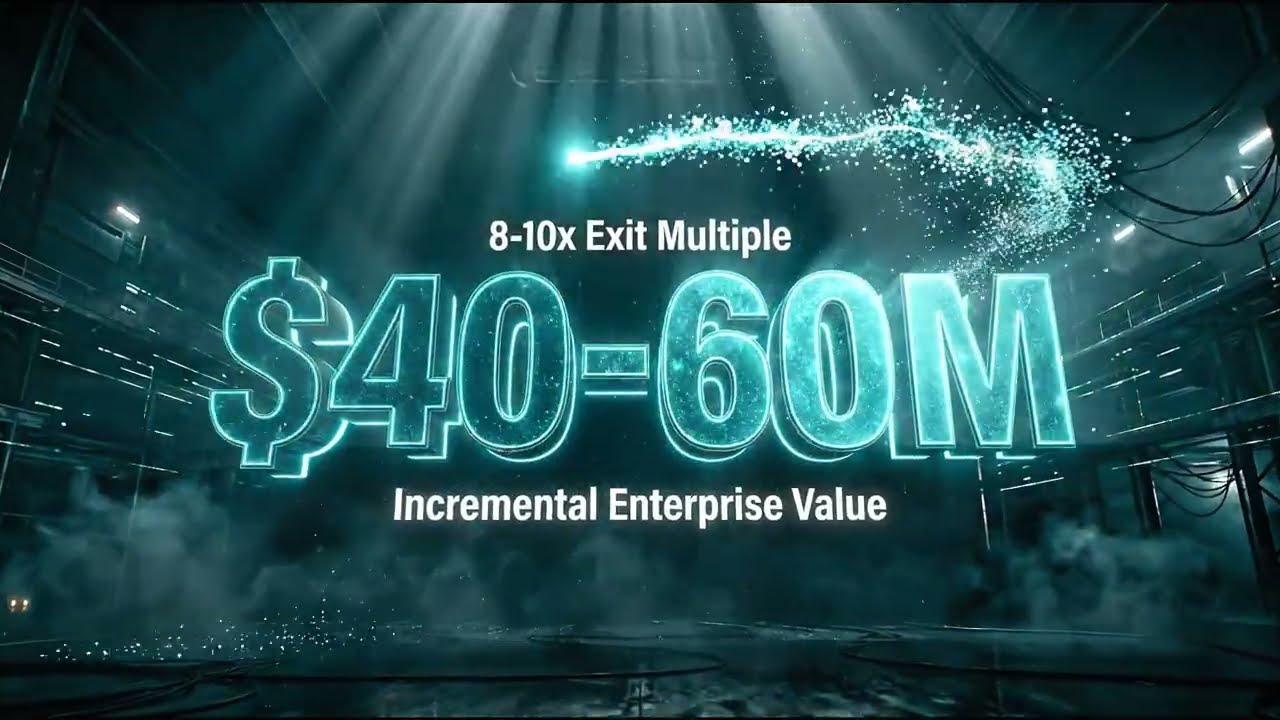
At an $18M EBITDA base (12% margin on $150M revenue), recovering the modeled $5.3M lifts exit EBITDA to roughly $24M. At a constant 8× exit multiple — no re-rating assumed — that's +$48M of enterprise value. The AI-native re-rating scenarios (10×–11×, with the capability documented in the data room) lift the bridge to +$96M and +$120M.
In the verified MOIC model — entry at 8.0×, 4.0× leverage, three-year hold, exit net debt deducted, AI uplift underwritten at the bankable 9–15% of baseline EBITDA — the deal moves from a 1.48× baseline (13.9% IRR) to a modeled 2.10× (28.1%) in the SEAS scenario at a 9.5× exit, and 2.55× (36.7%) in the full-execution scenario at 10.5×; the exit multiples reflect the modeled buyer premium for demonstrated AI-native operations. Held at a constant 8.0× with no re-rating, the same scenarios still model 1.66× and 1.78×. Every figure is a live formula in the MOIC Calculator workbook.
Even a partial implementation — capturing only a fraction of the modeled upside — creates enterprise value many multiples beyond the one-time cost of the system.
At $150M revenue / 12% margin / 8.0× entry, outputs match the exact published $150M Portco table (+$48M @ 8×, +$96M @ 10×, +$120M @ 11×). Dragging sliders scales dollar figures linearly across $50M–$500M.
Vetted by practitioners before it shipped.
Before release, SEAS was put in front of senior people in private equity and enterprise technology for independent review — not as customers, but as practitioners asked to pressure-test the logic, the models, and the claims. They reviewed it; they were not paid to endorse it. Employers are named for identification only and have not reviewed or endorsed SEAS.
Reviewers assessed SEAS before release and consented to be cited as independent reviewers. They are not customers and reviewed the framework rather than deploying it.
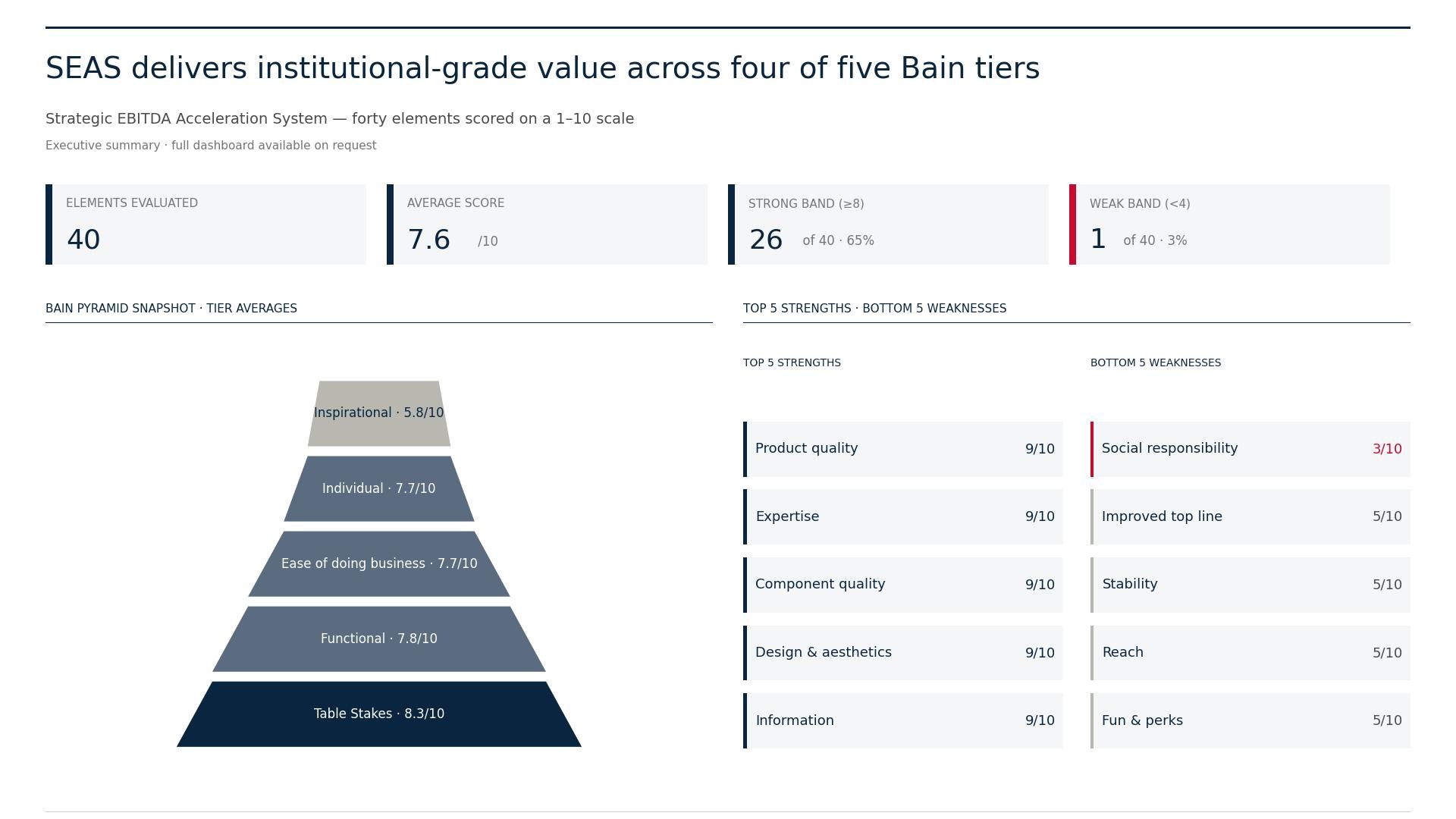
7.6 / 10 across 40 institutional value elements.
I scored SEAS myself against Bain & Company's B2B Elements of Value framework — a structured self-assessment, not a Bain engagement or endorsement. Twenty-six of forty elements rated in the strong band (≥8/10); only one rated in the weak band — Social Responsibility, definitionally outside scope for a PE value-creation product. The full scoring is below, so you can judge it yourself.
You can inspect it before you buy.
A $2,997 download you can't see into is a leap of faith — so here is the actual system. Every agent, the model that prices the upside, the software that runs the diagnosis, and the architecture that ties it all together. What stays behind the paywall is the operational substance: the production prompts, the live formulas, and the copy-and-run playbook. Everything that proves it's real is on this page.
All 35 agents, named
Nine cross-functional finance and operations agents that work in any company, plus 26 sector agents purpose-built for 13 industries. Knowing one exists tells you what it does. It does not let you rebuild it.
Capital Structure Agent
Watches covenant headroom four quarters out, simulates 20+ leverage scenarios, and flags breaches before they hit.
- Published Economics ($150M Reference Co.)
- Annual impact: $400K–$800K · Implementation cost: $80K–$150K · Payback: 2–4 mo
- Specification & Delivery in SEAS Suite
- Ships with full function, data inputs, decision logic, output, KPI, guardrails, and production system prompt inside the Strategic Agents Library & Agent Prompts Library.
What's actually inside one agent
Every one of the 35 ships with the same backbone — function, data inputs, decision logic, output, KPI, and guardrails. Two real examples below, fully structured. The one thing redacted is the production system prompt itself — that lives in the Agent Prompts Library, because the prompt is the product.
- Data inputs
- Internal financials — EBITDA forecast, leverage, cash position · External market data — rates, comparables · Covenant terms parsed directly from credit agreements
- Decision logic
- Ingest latest EBITDA forecast → compute covenant headroom for the next 4 quarters → simulate 20+ scenarios (base / upside / downside) → flag any breach within 6 months → recommend refinance, paydown, or capital reallocation, ranked by NPV.
- Output & KPI
- Covenant early-warning + ranked capital actions. Tracked on: quarters of headroom, breaches avoided, refinancing NPV captured.
- Guardrails
- Read-only access to source financials · recommendations require human sign-off · credit-agreement & OECD compliance checks.
- Data inputs
- Encounter records — CPT / ICD-10 / HCPCS, payer contracts, prior-auth status, denial history, AR ageing · External — payer / LCD / NCD updates, HFMA & MGMA benchmarks · Coding intelligence — code-to-denial matrix, undercoding model, appeal success rates
- Decision logic
- Pre-submission scan against payer rules → flag missing modifiers, auth gaps, code–diagnosis mismatches → auto-correct and resubmit denials within 24h → route complex cases to specialists with pre-built appeal packages.
- Output & KPI
- Higher clean-claim rate, lower rework time, recovered net revenue. Context: providers lose 4–7% of net revenue to denial leakage.
- Guardrails
- Clinician review for any coding change · no PHI leaves the environment · full audit trail.
The numbers, at the headline
The suite ships live, formula-driven Excel models — ROI, MOIC, EBITDA bridge, implementation budget. Here is the ROI summary they produce for the reference $150M company. The outputs are shown; the working formulas stay in the files.
| Strategic agent | Annual impact ($150M co.) | Implementation cost | Payback |
|---|---|---|---|
| Capital Structure | $400K–$800K | $80K–$150K | 2–4 mo |
| Tax Arbitrage | $500K–$1.2M | $100K–$200K | 2–5 mo |
| Contract Value Capture | $600K–$1.5M | $120K–$250K | 2–4 mo |
| Strategic finance agents, combined annual | $1.5M–$3.5M | operational agents are modeled per agent in the ROI Calculator workbook | |
=Recovered/Revenue). Shown here as output only; the working models ship inside the suite. Implementation cost ranges model a consultant- or vendor-led build; buyers implementing in-house with the included specifications substitute internal team time and tooling for most of that line — that substitution is the product's economic case.How the 35 agents fit together
Three layers, deployed through a six-phase rollout that cannot scale past a gate it has not cleared — all sitting on a documented governance stack.
EBITDA PathFinder Pro v3.0 — the diagnostic engine, module by module
The playbooks tell your team what to do. The software tells you where — on your own numbers. Enter your P&L, balance sheet, and retention data and it returns costed, risk-weighted optimization paths in minutes. It ships as a single file that runs in any browser on Macintosh, PC, or any operating system — no install, no login, no server, and it works fully offline. Your financials never leave your machine.
Vet it like a deal.
One company, start to finish — the reference model the playbook works through end to end — followed by the documents you can open and read right now. No form, no email.
A $150M-revenue mid-market company, $18M EBITDA, 12% margin. Acquired at 8.0× for a three-year hold. This is the representative company the entire playbook is modeled against.
A 90-minute diagnostic mapped the leakage to three pockets. Of roughly $12M identified, ~$5.3M was assessed as recoverable annually — the conservative, not the headline, figure.
Contract Value Capture went after unbilled clauses and escalators. Capital Structure freed covenant headroom and refinancing NPV. Tax Arbitrage re-rated the effective tax rate. Sector agents took the operational pockets — supply-chain and energy.
Each ran read-only first, recommending; humans approved before anything touched a system of record.
Nothing scaled on faith. At roughly week 8, the Phase-1 pilot had to clear all five thresholds before expansion was funded. Miss one, and the rollout pauses rather than spreads.
Recovery modeled at +$5.3M annual EBITDA, lifting margin from 12% to ~15.6% across the 12–18-month deployment. The verified MOIC model underwrites only the bankable 9–15% subset of baseline EBITDA — not the full $5.3M — and takes the deal from a 1.48× baseline to a modeled 2.10× at a 9.5× exit, and 2.55× in full execution at 10.5×; the re-rating (10×–11× scenarios) lifts the EV bridge by +$96M to +$120M — modeled as scenarios, not the base case.
Reference model used throughout the playbook. Figures are modeled ranges for a representative $150M company — illustrative of the method, not a guarantee of results.
Read the source material yourself
Three documents from the suite, available directly — orientation, positioning, and the sample inputs the models actually run on.
These are the orientation, positioning, and sample-input documents — open, no email required. The 35 full agent specifications, the production prompts, the live Excel models, and the 309-page playbook are the paid suite.
Don't trust me.
Verify everything.
There is no sales team behind this page. No discovery call is required, no webinar, no follow-up sequence pressuring you to decide. A 30-minute verification call is available if you want one, and it is not a pitch. That is a deliberate constraint — it means the product has to survive your scrutiny on its own. Here is what you can check before spending a dollar.
The numbers are counted, not rounded
1,711 verified Excel formulas across 9 workbooks. 309 pages. 35 agents — 9 cross-functional + 26 across 13 industry verticals. Odd, unrounded figures — because every one was audited and counted, not estimated for a headline.
Reviewed by named professionals — with their real names attached
The framework was independently reviewed by Abhishek Behera (Senior Tech Lead, Thomson Reuters) and Garvit Bhada (former private equity analyst, REA Group / Housing.com, now in US financial services). Both gave written consent to be named here.
These are peer reviews of the methodology — not customer testimonials. I label them exactly as what they are.
Your refund isn't in my hands
SEAS carries a 90-day money-back guarantee, and payment is processed by Polar as merchant of record. A refund request goes through their system — I can't stall it, renegotiate it, or make you sit through a retention call.
One price, one download, no lock-in
SEAS is a one-time download. No subscription that quietly renews, no "book a call for pricing," no upsell required to make the core product work. You pay once, you keep the files, and 90 days of email support is included.
Do not buy this if
- Your firm is under $50M in revenue — the leakage math won't justify the effort yet.
- You want done-for-you consulting. This is a self-execution system, not an engagement.
- You expect implementation support on calls. A 30-minute verification call is available before you buy; implementation support afterwards is by email only, by design.
- You need board-ready results without assigning an internal owner to run the 90-day plan.
Still skeptical? Good — that's the right instinct. The fastest way to test whether I'm right about your P&L is ARED (Automated Rapid EBITDA Diagnostics). It scores your firm's three-pocket EBITDA leakage on screen in 60 seconds for free — and if you want the formatted, board-ready PDF for your team or IC, it's $47.
Run free ARED scan →The reference model above is illustrative. This one isn't.
I pointed the SEAS diagnostic at a real, publicly traded mid-market manufacturer of protective clothing and safety apparel, using nothing but its public financial filings. The company is deliberately anonymized — it never asked to be analyzed, and I won't characterize a named business to make a point. Every figure below is a benchmark-based estimate of opportunity — the hypotheses SEAS puts on the table on day one — not a finding of waste. It is the most honest version of a worked case, and the more credible one.
The lens sized three pockets against best-in-class peer benchmarks: SG&A integration efficiency after a run of acquisitions, pricing harmonization across newly acquired brands, and procurement consolidation — plus a separate one-time working-capital release of $10–18M. Crucially, the analysis is netted against the company's own forward guidance, so it never double-counts the recovery management already expects. That reconciliation — a gross surface of $6–10M against a genuinely incremental subset of $3–6M — is what separates a credible diagnostic from a sales pitch. The document shows every assumption, every source, and every limit. It is what SEAS surfaces from the public record alone, before it has seen a single internal number.
Download the full worked case (PDF)You've seen inside. Now the math.
The agents, the models, the architecture, a worked example, an independent review — it's all on this page. There is nothing left to take on faith. What remains is a straightforward decision, and the numbers make it for you.
The agentic-AI edge compounds for whoever deploys it first. Every quarter you wait is margin a competitor banks instead of you — and the entry advantage narrows as the rest of the market catches up. The cost of acting is $2,997. The cost of waiting is measured in turns of MOIC.
Everything downloads at once
90-day, no-questions-asked guarantee
Download the entire system and put it to work through the full 90-day deployment window. If it doesn't show you where your EBITDA is leaking, one email gets you a full refund — no forms, no friction. The risk sits entirely with me. The only way to lose is to never look.
90-day deployment timeline. 90-day 100% refund guarantee. 90 days of email support. You're covered for the entire run. Every support email gets a reply within two business days.
90 days of direct email support — from the author
When you buy SEAS, your purchase includes limited post-purchase email support for 90 days. The complete system is yours to keep the moment you buy — and during those 90 days, the practitioner who built SEAS is reachable by email for questions on putting it to work: how to apply a model to your actual numbers, how to adapt a workbook to your company's structure, or how to sequence the rollout in your organization. Real guidance, in writing, on your schedule — no support queue, no bot — with replies within two business days. You're never left alone with the framework.
Please note: Support is limited to questions about applying the SEAS materials — not done-for-you work, custom analysis, or review of your data. It is general product guidance, not professional, financial, legal, investment, or management-consulting advice, and creates no advisory, consulting, or client relationship. This limited support is not equivalent to, and no substitute for, a full consultancy engagement or a qualified professional. Stated response times are targets, not guarantees; support is provided on a reasonable-efforts basis, and the 90-day period, scope, and availability may be limited or change. All decisions, implementation, and results remain your responsibility. Please do not send confidential or regulated data by email. Full Terms apply.
One license. Everything included. Zero ongoing fees.
No subscription. No per-seat license. No consulting retainer. Pay once and your whole team deploys immediately — with portfolio licensing available for firms rolling SEAS out across multiple companies.
- SEAS Master Playbook (6-phase architecture)
- RAPID SEAS Playbook (daily execution manual)
- 35-Agent Prompt Library (9 cross-functional + 26 industry-specific)
- Working Financial Model (Excel)
- EBITDA PathFinder Pro v3.0 diagnostic software — runs on Macintosh & PC, any operating system, fully offline
- Complete Templates Library (IC Memo, LP Update, CEO Briefing, AI Scorecard)
- Project Manager's Runbook with 29-milestone Gantt
- 90-Day Pilot Playbook + Agent Deployment Tracker
- Governance Deep-Dive (NIST, SOX, GDPR, CCPA, EU AI Act)
- FLOAT Diagnostic System
- ERP Data Export Guide + Vendor Landscape Matrix
- 90 days of direct email support from the author
A one-off roadmap is a report. SEAS is the engine.
A done-for-you AI advisory will build a custom EBITDA roadmap for a single portfolio company — typically $10,000–$20,000 per company, delivered in a couple of weeks, and you don’t keep the underlying system. SEAS hands you the system itself to own and reuse — deploy it in your company, and license it across a portfolio at a fraction of per-company consulting cost.
Building it in-house is the option most likely to fail. MIT's Project NANDA study The GenAI Divide: State of AI in Business 2025 (July 2025) found that AI tools bought from specialized vendors or built through partnerships reached successful deployment about 67 percent of the time, while internal builds succeeded about a third as often; in the report's own words, external partnerships see twice the success rate of internal builds. Sources: Fortune, August 18, 2025 and the report PDF.
- One custom report for one company
- Delivered in roughly two weeks
- Pay again for the next company
- You don’t keep the framework or the agents
- Implementation billed separately
- The complete system — 35 agents, models, full playbook
- Instant download, deploy the same day
- Deploy across your whole organization
- One payment for your organization — yours to keep
- Implementation tools included
Why This Book Exists
This Strategic EBITDA Acceleration System — The SEAS Playbook has been developed to remove/reduce the consultancy cost of $100K–$500K for mid-market firms in implementing agentic AI. It provides frameworks comparable to what top consulting firms deliver, at a fraction of the cost. If a $150M revenue firm follows the "FLOAT" 7-day stress test and identifies up to $5.3M+ in EBITDA leakages, the $2,997 price is just a "rounding error" and the projected ROI is 3–8x for Year 1 alone with implementation costs included.
Questions buyers ask first.
Operating roles: chief executive officers, chief operating officers and owner-operators at mid-market companies; portfolio-company chief executive, financial and operating officers; heads of finance and vice presidents of finance; vice presidents and directors of operations; heads of transformation; chief strategy officers; directors of innovation; project management office directors; and process excellence and Lean Six Sigma leads.
Independent practitioners: fractional chief financial, operating and artificial intelligence officers; interim chief executive, financial and operating officers; independent management consultants; boutique consulting firm partners; boutique artificial intelligence consultancy founders; turnaround and restructuring leads; and digital transformation consultants, who deploy SEAS as a ready-built methodology across client engagements.
Investors and deal professionals: private equity operating group and portfolio operations leads; independent sponsors; search fund operators; family office operating partners and direct investors; growth equity and venture capital operating partners; corporate development directors; mergers and acquisitions and post-merger integration leads; quality of earnings providers; mid-market investment bankers; and independent board directors and advisors.
Technology, risk and governance: chief information, technology, digital and data officers; heads of artificial intelligence and artificial intelligence strategy; chief risk and chief compliance officers; and internal audit and artificial intelligence risk leads, who use the governance dossier, the non-human identity access policy and the NIST AI RMF mapping.
Sector operators: healthcare system chief operating and financial officers; manufacturing vice presidents of operations; business-to-business software chief operating officers; distribution and logistics operations directors; professional services operations leads; and insurance and banking operations directors, each served by the 26 industry agents across 13 verticals.
Academic and research users: business school and finance faculty; professors of operations, accounting, information systems and entrepreneurship; doctoral and master of business administration students; executive education and corporate training programs; university research centres and think tanks studying artificial intelligence adoption, productivity and value creation; and case writers, who use the worked case, the diagnostic method, the agent specifications and the nine workbooks as teaching material and as a documented reference implementation. Classroom or multi-seat academic use needs a separate licence, so write to me before distributing it to a cohort.
Two limits worth stating. Under $50M in revenue the leakage math rarely justifies the effort. And SEAS assumes someone in the room owns the earnings number; without that owner, no playbook survives contact with the quarter.
Day 1. Read the Read Me First, then Sections 1 to 3 of RAPID SEAS, the daily execution manual. About three hours.
Day 2. Run the FLOAT diagnostic on your trailing twelve-month P&L: 90 minutes, three pockets (SG&A gap, pricing and contract drift, supply chain and vendor concentration), at least three quantified EBITDA opportunities. Same afternoon, paste the relevant agent prompts into Claude, ChatGPT or Gemini with your own CSV exports and see the leak in your numbers, not the reference company's.
Days 3 to 7. Run the Data Fitness Scorecard on the target workflow (a 500-record audit; 70 percent or better to proceed). Populate the EBITDA Analysis Report and the Simple ROI Calculator for a board-ready number. Shortlist vendors with the Vendor Matrix and send the request for proposal template. Brief the executive sponsor. Populate the 10-slide Board Deck and present it for pilot approval.
Weeks minus 4 to 0, Phase 0. Preparation: baseline metrics recorded, vendor demos scored on the weighted matrix, contract and SLA addendum signed, steering committee and AI Acceptable Use Policy in place. The Project Manager’s Runbook runs this stage week by week.
Weeks 1 to 8, Phase 1. One operational workflow, typically accounts payable, in parallel run, read-only first, humans approving every action. At the end of week 8 the go/no-go gate applies measured thresholds: accuracy above 90 percent, cycle time down 25 percent or more, cost per transaction down 15 percent or more, exceptions under 8 percent. Modeled Phase 1 target for the $150M reference company: $500K to $1M cumulative EBITDA plus working capital freed.
Weeks 9 to 24, Phase 2. Controlled production and tuning to 98 percent accuracy and under 2 percent exceptions, then Gate 2 at week 24. Nothing expands until it clears.
Weeks 25 to 52, Phase 3. Three to four additional workflows, monthly steering, cross-department coordination. The strategic agents (capital structure, tax, contract value capture and the sector agents) layer in from month 7, once the operational layer is producing validated EBITDA.
Weeks 53 to 78, Phase 4. Five or more workflows at scale, quarterly governance audits, and exit preparation from week 68: the governance dossier, unit economics documentation and the CIM section draft. Modeled cumulative EBITDA at month 18: $4M to $6M.
Months 19 to 24 and beyond, Phase 5. Optimization, the bonus systems, and fund-level reporting through the Fund-Level Deck. Modeled cumulative: $6M to $10M.
Throughout. Weekly metrics every Friday, a three-level escalation matrix, exception protocols and sustainment budgeting come from the Runbook; email support from the author for 90 days; a 100 percent refund within 90 days from date of purchase. All EBITDA figures above are modeled on the $150M reference company, not customer results, and depend on your data quality, your team and your implementation budget.
Practical guides and the evidence behind EBITDA uplift.
Eight guides you can act on this week, each built from a working part of the system, and six analyses of what the research actually shows about turning agentic AI into margin.